
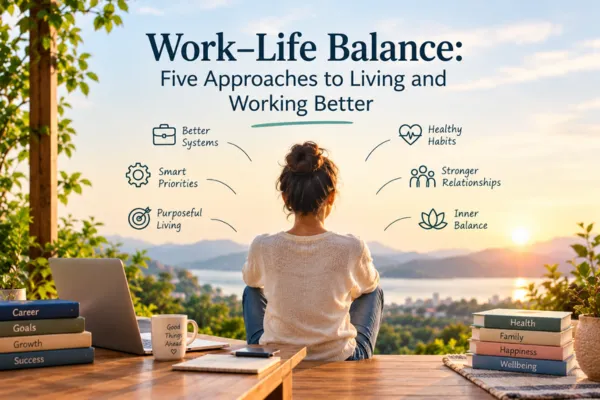
Redefining success through self-awareness, sustainable habits, purposeful work, and inner balance
Introduction: Is Work–Life Balance Really Possible?
In today’s fast-paced world, work–life balance has become an important concern for professionals, entrepreneurs, business leaders, and working families. Long working hours, constant connectivity, demanding responsibilities, and the pressure to succeed can gradually affect our physical health, emotional well-being, relationships, and quality of life.
However, work–life balance does not mean dividing every day equally between work and personal life. It means creating a sustainable way of living in which professional responsibilities and personal well-being can coexist.
There is no single formula that works for everyone. A young professional, a parent, an entrepreneur, and a senior executive may have very different needs and responsibilities. The key is to recognise one’s current situation and choose an approach that supports both well-being and meaningful achievement.
Five approaches can help us understand this journey: updating daily routines, resetting life when necessary, compartmentalising responsibilities, developing effective systems, and becoming a Karma Yogi.
1. Update Your Dinacharya: Build Balance Through Daily Habits

The first step towards a healthier life is to examine our daily routine, or Dinacharya. Small, consistent habits can influence how we manage energy, stress, concentration, and recovery.
Burnout rarely develops overnight. Persistent exhaustion, growing cynicism or detachment from work, and reduced professional effectiveness may indicate that a person is struggling. Recognising these changes early provides an opportunity to reassess priorities and make meaningful adjustments.
Instead of waiting until exhaustion becomes overwhelming, we can begin by improving our everyday habits.
Practical steps include:
- Establish a consistent sleep and wake-up schedule.
- Create a calm, structured morning routine.
- Include physical activity, mindfulness, or meditation according to individual needs.
- Take regular breaks and protect time for recovery.
- Review the day’s priorities rather than responding continuously to every demand.
- Make time for family, hobbies, and meaningful social connections.
One practical approach is to reserve a dedicated period each day for a morning wellness routine. Depending on individual circumstances, this may include exercise, breathing practices, meditation, planning, or other healthy activities.
The objective is not to create a perfect routine. It is to develop habits that are realistic, sustainable, and supportive of long-term well-being.
The principle is simple: recognise the warning signs early and work on your Dinacharya before stress becomes a more serious problem.
2. Reset Your Life: Know When Small Changes Are Not Enough
Sometimes, improving daily habits is insufficient. If a person’s work environment, responsibilities, or lifestyle continues to create excessive strain, a more substantial change may be necessary.
A life reset begins with an honest assessment of one’s circumstances. Are the demands of work consistently exceeding one’s capacity? Is there enough time for sleep, relationships, recreation, and recovery? Has work begun to dominate almost every aspect of life?
When these imbalances persist, it may be time to reconsider the structure of one’s professional life.
- Reduce working hours: Where feasible, negotiate more manageable hours, delegate responsibilities, or establish clearer boundaries between work and personal time.
- Change roles or professions: If the current role is persistently incompatible with personal well-being, exploring another position, organisation, or career path may be appropriate.
- Redefine financial and lifestyle goals: Understanding one’s financial needs can help identify whether a less demanding role, a different business model, or a simpler lifestyle is achievable.
- Make room for meaningful interests: For people with sufficient financial security, dedicating more time to hobbies, creative pursuits, volunteering, learning, or other personally meaningful activities may improve life satisfaction.
Such decisions should be made thoughtfully, taking into account financial commitments, family responsibilities, career opportunities, and individual health needs.
A reset does not necessarily mean abandoning ambition. It means redefining success so that professional achievement does not come at the expense of a meaningful and sustainable life.
3. Compartmentalise Life: Give Each Responsibility Its Place
People in demanding leadership positions often face competing expectations. Senior executives, entrepreneurs, public figures, and other professionals may need to make complex decisions while remaining attentive to their families, personal health, and other responsibilities.
For such individuals, compartmentalisation can be a useful strategy.
Compartmentalisation, in this context, means directing attention towards the responsibility that requires it at a particular time instead of allowing every concern to occupy the mind simultaneously.
For example, during an important meeting, a leader focuses on the decision at hand. During family time, the same person makes a conscious effort to be present with loved ones.
This approach can be supported by several practical habits:
- Set clear boundaries: Define working hours and establish expectations about availability.
- Practise focused attention: Work on one important task at a time whenever possible.
- Create transition rituals: Use a short walk, a few minutes of breathing, or a brief review of the day to transition between work and home.
- Develop peak-performance habits: Prioritise adequate sleep, physical activity, preparation, recovery, and deliberate practice.
- Learn to disengage: Recognise when a task can wait until the next working period.
Compartmentalisation should not mean suppressing emotions or ignoring serious problems. It is a way to manage attention while remaining emotionally aware and responsive to important needs.
The goal is to give each area of life appropriate attention rather than allowing professional pressures to spill into every moment.
4. Develop Systems: Move from Constant Effort to Sustainable Effectiveness
Many people attempt to solve work–life imbalance by working harder and extending their working hours. Yet, increasing effort indefinitely is neither practical nor sustainable.
A more effective approach is to examine the systems through which work gets done.
This involves identifying unnecessary tasks, simplifying processes, delegating appropriately, using technology responsibly, and creating ways to achieve meaningful outcomes without personally managing every detail.
The philosophy is to move from being constantly occupied to becoming more effective.
The DEAL Framework
Inspired by the ideas popularised by Tim Ferriss in The 4-Hour Workweek, the following framework offers a useful way to rethink work and lifestyle design.
- D — Define the life you wish to live. Begin with the desired outcome. What does a successful life look like to you? Consider your health, relationships, financial needs, freedom, professional purpose, and personal interests.
- E — Eliminate unnecessary tasks. Examine how you spend your time. Identify activities that do not meaningfully contribute to your goals. Reduce unnecessary meetings, repetitive work, avoidable interruptions, and low-value commitments wherever possible.
- A — Automate and systematise where appropriate. Use technology, standard operating procedures, and repeatable processes to reduce avoidable manual effort. Business owners and leaders may also delegate suitable responsibilities to trained team members.
- L — Liberate yourself from unnecessary time and location constraints. Where the nature of the work permits, consider flexible schedules, remote working, and outcome-based performance measures. Build professional systems that allow greater control over when and where work is performed.
These options are not equally available in every profession. Healthcare, manufacturing, customer-facing services, and many other roles require physical presence or fixed schedules. Even in such settings, better staffing, delegation, workflow design, and predictable time off can improve work–life balance.
The broader lesson is that freedom often begins with thoughtful design rather than simply working longer hours.
Building a More Effective System
Developing an efficient team, documenting processes, leveraging appropriate assets, and creating additional income streams may help some individuals gain greater financial and professional flexibility. However, passive income is not guaranteed, and building sustainable systems generally requires planning, capital, time, and ongoing oversight.
The purpose is not to eliminate work altogether. It is to ensure that work serves the life one wants to build.
5. Become a Karma Yogi: Transform Work into a Meaningful Offering
The fifth approach brings together professional responsibility, personal values, and spiritual understanding.
In the Indian philosophical tradition, Karma Yoga refers to the path of selfless action. The Bhagavad Gita teaches the importance of performing one’s duties sincerely while cultivating a balanced attitude towards the results of those actions.
This perspective offers a meaningful way to rethink our relationship with work.
Work as a Mission
When work is connected to a meaningful purpose, everyday responsibilities can acquire greater significance. A healthcare professional, for example, may see work not simply as a series of appointments but as an opportunity to improve patients’ lives.
A teacher may view education as a contribution to society, while a business leader may see leadership as an opportunity to create value and support the growth of others.
Purpose does not remove the difficulties of work, but it can help individuals understand why their efforts matter.
Accept the Outcome Without Losing Your Balance
One of the central teachings of the Bhagavad Gita is that we should focus on our actions rather than become excessively attached to their results.
This does not mean abandoning goals, avoiding responsibility, or becoming indifferent to performance. Instead, it means giving our best effort while recognising that outcomes are influenced by factors beyond our complete control.
We can prepare thoroughly, make thoughtful decisions, act ethically, and learn from feedback. However, we cannot guarantee every result.
This distinction can help reduce unnecessary frustration and encourage a more balanced response to success and failure.
Work as Worship
The idea of treating work as worship encourages sincerity, discipline, integrity, and dedication in whatever responsibility we undertake.
When work becomes an offering rather than merely a pursuit of personal recognition, our relationship with it can change. We may become more attentive to the quality of our actions, the people we serve, and the contribution we make.
At the same time, Karma Yoga should not be interpreted as an obligation to tolerate exploitation, neglect health, or sacrifice every personal need. Rest, family responsibilities, and self-care are also important aspects of a responsible life.
The essence of Karma Yoga is to act with dedication, serve with sincerity, and maintain inner balance without allowing the outcome alone to define our worth.
The Science and Philosophy of a Balanced Life
These five approaches combine practical lifestyle management with a broader philosophy of purposeful living.
Scientific research provides support for some of the practices discussed here. The World Health Organization identifies burnout as an occupational phenomenon associated with chronic workplace stress that has not been successfully managed. Its defining dimensions include exhaustion, mental distance or cynicism towards work, and reduced professional efficacy.
A systematic review and meta-analysis published in Mindfulness in 2023 examined 91 studies involving workplace mindfulness interventions. The researchers reported improvements across several outcomes, including well-being, mental health, and stress, while also noting limitations such as variation in study quality and the need for further research on longer-term effects.
These findings support the value of considering practical stress-management strategies, but they do not establish that any single routine or philosophy will work for everyone.
Equally important is recognising that work–life balance is not solely an individual’s responsibility. Organisations also influence employee well-being through workload, leadership, staffing, flexibility, workplace culture, and opportunities for recovery.
A sustainable approach therefore requires both personal awareness and supportive working conditions.
Bringing the Five Approaches Together
- Update your Dinacharya when your everyday habits need improvement and you want to build resilience before stress becomes overwhelming.
- Reset your life when persistent imbalance requires significant changes to your schedule, role, or lifestyle.
- Compartmentalise life when competing responsibilities require greater focus, clearer boundaries, and better transitions between roles.
- Develop systems when unnecessary work, inefficient processes, or excessive dependence on individual effort are limiting your freedom.
- Become a Karma Yogi when you want to connect your actions with purpose, service, and a balanced attitude towards outcomes.
These approaches are not mutually exclusive. A person may improve their daily routine while redesigning professional systems and cultivating a more purposeful attitude towards work.
The right combination will depend on individual circumstances, responsibilities, values, and resources.
Conclusion: The Bottom Line Is to Live Better
Work–life balance is not a fixed destination. It is an ongoing process of understanding ourselves, responding to changing circumstances, and making choices that support a meaningful life.
Some people may achieve greater balance through small daily habits. Others may need to change their professional direction, build more efficient systems, or reconsider what success means to them. Still others may find strength in approaching their work as a form of service.
There is no universal formula because people lead different lives and face different challenges.
The important questions are: Are we taking care of our health? Are we present for the people who matter to us? Does our work reflect our values? Are we using our time meaningfully? And are we creating a life that we genuinely wish to live?
The answers may evolve over time, and our approach should evolve with them.
Ultimately, the purpose of work–life balance is not merely to work less or accomplish more. It is to create a life in which achievement, well-being, relationships, and purpose can coexist.
Different people need different approaches to work–life balance. The ultimate goal, however, remains the same: to live better.
References and Further Reading
- World Health Organization. Burn-out an occupational phenomenon: International Classification of Diseases. WHO, 2019. https://www.who.int/news/item/28-05-2019-burn-out-an-occupational-phenomenon-international-classification-of-diseases
- Michaelsen, M. M., et al. (2023). Mindfulness-Based and Mindfulness-Informed Interventions at the Workplace: A Systematic Review and Meta-Regression Analysis of RCTs. Mindfulness, 14, 1271–1304. https://link.springer.com/article/10.1007/s12671-023-02130-7
- Ferriss, T. (2007). The 4-Hour Workweek: Escape 9–5, Live Anywhere, and Join the New Rich. Crown Publishing Group.
- The Bhagavad Gita, particularly Chapter 2, verses 47–48, on action, attachment to outcomes, and equanimity. Interpretations may vary across translations and philosophical traditions.
Editorial note: Before publication, Dr. Vijay Deshmukh’s preferred interpretation of Dinacharya, Karma Yoga, and the five approaches can be reviewed to ensure that the article reflects his philosophy precisely.